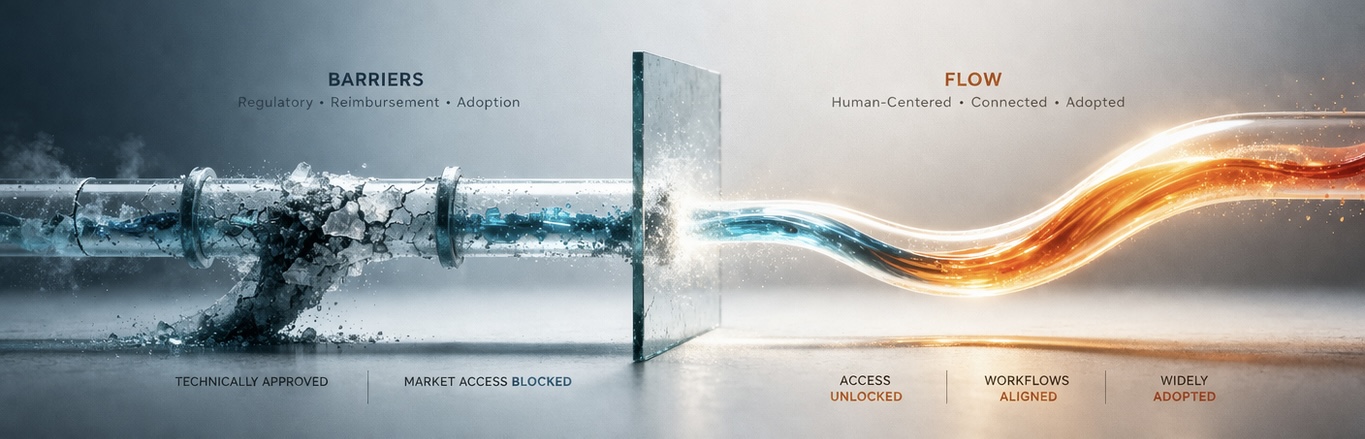
Regulatory approval is a milestone. Adoption is the destination.
The device works. The evidence is solid. What gets it to patients is understanding every human in the system — and building the conditions for each of them to move.
Adoption doesn’t fail because the device is wrong.
It fails because of what happens between what a company believes about its product and what a customer actually needs to hear. Three layers. Rarely in dialogue. Almost always the source of the problem.
Layer 01
What the company believes
The clinical evidence is strong. The device works. The strategy is built. The brief has been given to the field.
→
Layer 02
What the rep communicates
Generic messaging. Approved materials. A training day from six months ago. A question they can’t answer in the room.
→
Layer 03
What the customer actually needs
A specific answer to a specific clinical question. In this conversation. Right now. From someone who understands how this environment operates.
This is a behaviour gap, not an information gap. The information exists. The system to deliver it — in the room, at the right moment, to the right person — almost never does. Lumenara bridges that gap.
“Technically approved is where most devices are. Widely adopted is where they need to be.”
A repeatable engagement model built from 17 years of what actually works inside medical device commercialisation. Each phase has a defined output. Nothing moves forward until the output is real.
Phase 01
Diagnostic
Understand the specific adoption barrier. Clinical, commercial, or structural. We don’t start with recommendations until we know what’s actually blocking — because activity without diagnosis accelerates whatever is already happening, including the failure.
Phase 02
The full human experience
Stakeholder Map
Map every decision-maker and influencer in the buying pathway. What they protect. What they need to hear. Where the current strategy is missing. The commercial message that resonates with one stakeholder actively alienates another. This is where the Observer Flow Framework is applied.
Phase 03
Strategy Build
Clinical adoption pathway. Commercial messaging matrix. Market access approach. Built for the specific product, trust type, and buying cycle. Not repurposed from another launch. Specific to this device and this system.
Phase 04
Implementation
Working directly with the commercial team until the approach is operational. Not a handover document. A working engagement. We are in the field conversation, the board room, and the procurement meeting until adoption moves.
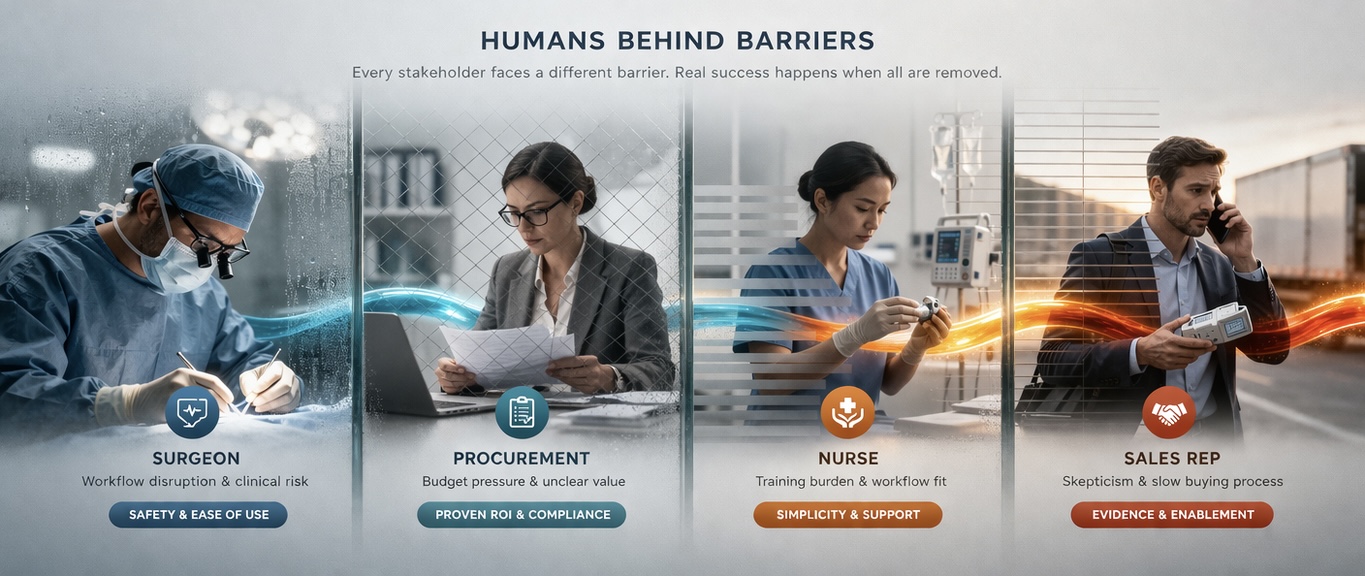
“Every stakeholder faces a different barrier. Real success happens when all are removed.”
Surgeon · Procurement · Nurse · Theatre manager
The Observer Flow Framework
The missing key to unlocking performance.
Commercial strategy is planned at a sophisticated level. The product works. The evidence is solid. The stakeholder map is built. Then a conversation goes wrong, a decision is made from pressure rather than clarity, or a leader’s identity gets tangled with an outcome. The Observer Flow Framework addresses what almost no business framework touches: the internal operating system of the person running the strategy.
This framework did not come from management theory. It emerged from lived experience — the full account is in UbU by Arun Kumar — then verified independently against Vedic psychology and contemporary neuroscience. That origin is precisely why it works where other frameworks do not: it was tested on a human being under real pressure before it was applied to a commercial conversation.
Step 1 — Observe
Catch it before it becomes a decision
The pause between stimulus and response is where commercial judgement lives. You are not the pressure. You are the one noticing it.
Step 2 — Name it
Which pattern is running?
Identity protection. Fear of the board conversation. The need for approval from the clinical champion. What you cannot name owns your strategy.
Step 3 — Thank it
Complete the arc, don’t suppress it
Acknowledge what the feeling was trying to do. Suppression keeps it in the room. Completion frees the decision from it.
Step 4 — Return
Return to the mission
Not back to the noise or the pressure. Back to why the work matters. The business mission as compass — the orientation that holds when everything else is pulling.
What it looks like in the room
“My re-excision rate is already below the national average. I’m not sure what this adds to my practice.”
Mr Holloway, consultant breast surgeon. This is not a clinical objection. It is identity protection. He has built professional pride around this number. Barrier: workflow and identity protection.
Observer Flow redirect: “That’s a strong result — genuinely. I’m curious about one thing: what happens to that number when your registrars are leading the list without you in the room?”
Time in call: 4 minutes · 73% continuation rate in comparable accounts
Where it changes business outcomes
High-stakes decisions
Clarity under pressure
Board presentations, adoption pivots, distributor negotiations. Observer Flow trains the pause that separates a reactive call from a clear one.
Team performance
The operating system, not the skill set
The gap between what a commercial team can do and what it does under pressure is almost always internal.
Leadership identity
The leader in the observer state
Post-launch stalls and restructures test every leader. The one who can observe rather than react recovers faster.
The cost of your strategy
Most MedTech companies know something isn’t working.
Most don’t know what it’s costing them, or why. Select the scenario closest to where you are.
Phase 02 · The full human experience
The conversation in the room is where adoption advances or stalls.
The same product. The same clinical evidence. Six different humans in the system — each protecting something different. The message that moves one actively alienates another.
Surgeon
“In oncoplastic cases with your patient profile, uncontrolled perioperative glucose is the single most modifiable risk factor for wound complications.”
Barrier: identity and clinical pride. Observer Flow redirect: shift from the device to what happens when he is not in the room.
Anaesthetist
“This doesn’t add a step to your workflow. It removes one.”
Barrier: workflow disruption. The conversation starts with the workflow, not the device.
Theatre Manager
“Royal Surrey went live in three weeks. Average list disruption in the first month: eleven minutes. By week six: net neutral.”
Barrier: theatre time and list management. Needs evidence from a comparable institution, not a reference centre.
Procurement Lead
“The device cost is offset against the avoided cost of a single SSI event in your trust. The economics are straightforward.”
Barrier: budget and value evidence. The economic case must be built for this trust, not repurposed from elsewhere.
Medical Director
“MHRA-cleared, CE marked, integrated with your existing infrastructure. The governance pathway is straightforward.”
Barrier: governance and risk. Lead with compliance and governance, not clinical innovation.
Scrub Nurse Lead
“I’m not asking you to commit to anything. I’m asking if you’d be willing to spend forty minutes with the scrub lead at a trust that’s been using it for six months.”
Barrier: training burden and change resistance. Peer-to-peer evidence from equivalent role, not from management.
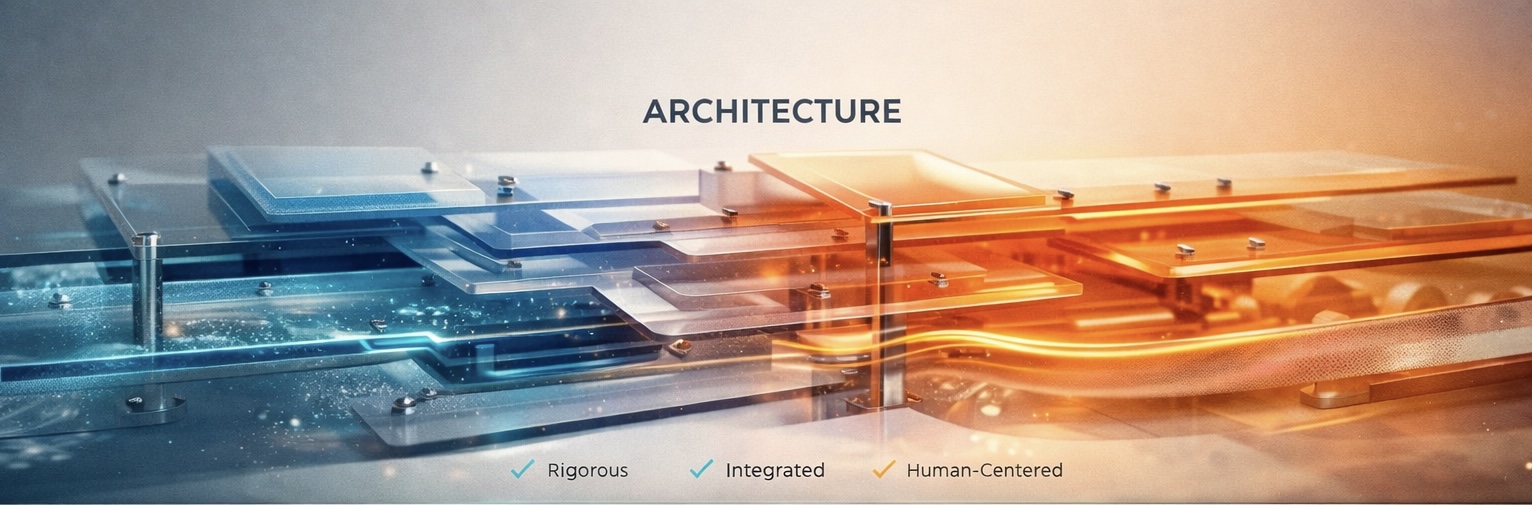
“Rigorous architecture. Built for the human system, not the pathway document.”
Rigorous · Integrated · Human-centred
Patterns that repeat
Built from inside the launches and the stalls.
These are the patterns that repeat. Across therapy areas, commercial models, and market stages. Not theory — lived experience from inside the launches, the stalls, and the recoveries.
Adoption sequencing · Reference vs usage
The 12-Month Gap: Why Yes Is Not Adoption
The distance between a surgeon saying yes in principle and consistent theatre use runs 12 to 24 months. Commercial forecasts that ignore this sequence consistently underperform. Planning the sequence before starting the clock is what separates launches from stalls.
Every hospital has a procurement lead, a devices committee, a clinical governance sign-off, and a budget holder whose cycle does not align with the launch timeline. The commercial message that resonates with one stakeholder actively alienates another.
Activity without diagnosis does not fix an adoption problem. Post-launch stalls have a small number of root causes — wrong site type, wrong stakeholder, wrong message — each requiring a completely different response. The instinct to increase activity is almost always wrong.
Each engagement is structured around a defined commercial question. Not general advisory retainers. Specific problems with a clear diagnostic, a built strategy, and a working implementation.
Clinical Adoption Strategy
Stakeholder mapping, reference and usage site strategy, workflow integration, training architecture, health economic evidence calibrated to audience.
Reference vs usage site distinction — built explicitly
Stakeholder map: what each buyer protects, what they need to hear
Commercial messaging matrix by stakeholder
NHS procurement and ICS engagement
The sequence that works: Secure KOL commitment with clinical trial architecture. Use that name to unlock secondary academic centres. Only then approach workhorse hospitals with the commercial model built in real time. Timeline: 18 months from KOL engagement to first scalable usage site. Second site: 40% faster.
Early Market Architecture
Phase 1 sequencing, site prioritisation, investor narrative, UKCA and EU MDR commercial strategy, AHSN adoption pathways.
Pre-launch adoption architecture — reference and usage from day one
KOL identification and commitment strategy
Early market sequencing and site prioritisation
Investor commercial narrative built on realistic adoption timelines
Commercial & Clinical Advisory
Ongoing partnership combining senior commercial experience with active clinical practice intelligence. For companies that need the clinical environment understood from the inside.
Board-level commercial diagnosis and recovery planning
Distributor network development and management
European market entry strategy
KOL development and centre of excellence design
Adoption Recovery
For launches that have stalled. Root cause diagnostic before any new activity. A rebuilt pathway to scale based on what the system actually requires — not what the launch plan assumed.
Root cause diagnostic — reference vs usage site distinction
Stakeholder barrier reassessment
Economic case rebuild for procurement audience
Re-sequenced adoption programme with clear milestones
About Lumenara
Built from inside the commercial environment.
Arun Kumar — Founder
17 years of director-level commercial experience in medical devices across UK and European markets. Sports medicine, hernia, gynaecology, neuromodulation, and cardiac implants. Inside the launches, the stalls, and the recoveries.
The core insight driving every engagement: most commercial strategies for MedTech are built by people who understand either the clinical environment or the commercial one. Rarely both. The gap between them is where products stall.
Lumenara works with a small number of engagements at any time. Not because of capacity — because the work requires full attention to a specific commercial problem. Based in Solihull, UK. Operating across UK and European markets.
Honest answers to the questions we hear before almost every engagement.
A reference site is a prestigious academic centre that provides clinical credibility and endorsement. A usage site is a high-volume workhorse hospital where the device must function as part of routine practice at scale. Reference sites value innovation and clinical conversation. Usage sites value workflow fit, training simplicity, and a clear economic case. Confusing the two is one of the most common reasons MedTech launches stall after strong initial reference site performance.
Because they require completely different engagement strategies. A reference site adopts because of clinical interest. A usage site adopts because the device fits the workflow, the training burden is manageable, and the economic case is compelling for that specific audience. Companies that apply the reference site playbook to usage sites consistently find the model does not transfer.
The Observer Flow Framework is a four-step practice — Observe, Name It, Thank It, Return — developed by Arun Kumar from lived experience and verified against Vedic philosophy and contemporary neuroscience. In a business context, it addresses the internal operating system of the person running the commercial strategy. It is not a mindfulness tool. It is a performance tool. The full framework is in the book UbU at ubuobserver.com.
Three things happen. The board conversation shifts from explaining underperformance to presenting a clear adoption pipeline. The workhorse hospital becomes a commercial proof point — evidence the model works at scale. And adoption compounds: each new site moves faster than the last because the understanding of how that type of hospital operates transfers. The second usage site adoption runs approximately 40% faster than the first when the model is built correctly.
Typically 18–36 months from first usage site engagement to a model that genuinely replicates. This reflects the patience required to understand how a workhorse hospital actually operates and translate that into a commercial approach. Companies that try to compress this timeline consistently find the model breaks down at the third or fourth site.
Yes. We work across UK and European markets, with specific experience in Germany, France, the Netherlands, and Ireland. We also work with US and global companies entering European markets, particularly around UKCA and EU MDR commercial strategy and NHS system navigation.
Because every human in every system has a different barrier. The surgeon faces workflow disruption. Procurement faces budget pressure and unclear value. The nursing team faces training burden. The sales representative faces scepticism from a team that has seen too many launches. Real adoption happens when all barriers are removed — not just the most visible one.
The surgeon wanted it. The evidence was strong. It still didn’t move. Healthcare systems are designed to slow down the introduction of new things — the procurement lead, the devices committee, the theatre manager who runs the list. The commercial strategy that maps only the clinical champion misses the system around them. That system is where adoption stalls.
The gap between a clinician saying yes and that device becoming part of regular practice runs 12 to 24 months — not because they changed their mind, but because the system around them is not designed to make adoption easy. Training, procurement, theatre lists, governance sign-off. The commercial strategy that treats the surgeon’s yes as the end of the conversation consistently underperforms the one that treats it as the beginning.
Start the conversation
If you want the numbers to follow the investment — let’s talk.
Not a discovery call that ends in a proposal. A real conversation about where you are, what kind of sites you are working with, and whether we are the right fit.
Tell us the situation. We will tell you what we see — including if what you need is not us.